Toastmasters turns 100, but so what? The parent organisation is having a moment as it remembers the very first meeting, convened by the founder, Ralph Smedley, on 22 October 1924. But how is that relevant to members in New Zealand in 2024?
It’s relevant because at the back of the celebrations is a story. The story says, ‘look at this! We have been so valued by people since 1924 that Toastmasters has spread across the globe and has thrived!’ It’s a compelling, if simplified, tale. But it is essentially valid and uplifting, and we are exposed to many versions of the same message over the years.
We are no more or less than the stories we tell, to ourselves and to others. Our stores are the track of our path through life, even through time itself. Behind the big story of the organisation, there are myriad stories of individuals. People join Toastmasters to become competent, confident speakers, but their stories are all so different. That’s why the speeches we hear can be so enthralling; we are given a privileged insight into somebody else’s world. The stories unite us. Even the sharing of individual stories builds a feeling of community in a club. I have experienced that over and over.
The stories we tell have lasting effect. One member who is a recent immigrant from China, recently spoke about being exposed to a different version of the story of the Korean War from the one she learned at school in the PRC. She learned that it was the North that invaded the South in 1950, and not, as she had been taught, that US forces invaded the North. Of course she experienced dissonance as she processed a different narrative from the one she was taught as a child. It’s the age-old story of propaganda, effective because we interpret the world through stories. The speaker’s conclusion from what she had learned is that more than one source needs to tell stories about important events; there are two sides to every story.
Researchers suggest that telling stories is one of the most important things we do. Perhaps it is the most important of all. Without our stories, who are we? But we need to be careful which stories we tell, both to ourselves and to other people. Stories have the power to change people. They are the only thing that can. In the end, our stories do not just define us; they are, quite literally, all we have.
O, wad some Power the giftie gie us To see oursels as others see us!
Once I found my career niche (running my own business), I happily watched and learned from others, and went looking for ideas and advice when I needed them. Keeping eyes and ears open in the direction of those who are successful in your field is one of the important ways to grow. My business was in a field where collaboration was common, and there was a culture of support between similar businesses around the country. Sometimes we all learned together; sometimes we were able to learn from each other.
There is another type of advice from that which you actively seek. I’m talking, of course, about unsolicited advice. When I was a kid, one of the Scottish sayings that came out of my mother’s mouth on a regular basis was a quote from Robbie Burns:
‘O, wad some Power the giftie gie us To see oursels as others see us!’
This is, of course, a classic reminder, in the dour Scottish tradition of telling children not to get too big for their boots, that it is an enormous favour to see ourselves as we appear in the eyes of others, for then we have the opportunity to fine-tune our behaviour and become better people. Mum would follow up the quote with something quite succinct about something that she didn’t like. I realise now that this felt like judgement, and that is how I absorbed it. Sad to say, I don’t recall praise as the adjunct to these words.
The author being constrained by his mother in 1959. Too young to take advice, so put on a leash until further notice.
It came as a surprise when I realised that I had built a wall of ego around myself. I am not going to analyse that here, but I understand now that I was trying to protect myself from the consequences of being judged. I remember the embarrassment I felt the first few times when I was evaluated at Toastmasters. I can remember even going to the extent of placing my face in my hands as my arms rested on the table in front of me, and pretending to concentrate. In reality, I was hiding from the gift I was being given, fighting to separate well-intended advice from judgement. This seems odd, since evaluations are solicited advice, like the advice I sought in business. But they felt like they were unsolicited, because of course a Toastmasters evaluation is personal; it is the gift of seeing ourselves as others see us. Gradually I have come to listen eagerly for what my evaluators say. Toastmasters has taught me that other people can have valid views about what you do; views that are not judgement, but support. Today I watch other members go on their personal growth tracks through evaluation and self-reflection, and I can look back and see my own growth. I completely accept the power of advice given in the right spirit by sincere people.
It came as a surprise a few years ago when a fellow club member offered me advice on an approach I was taking to getting members’ engagement. I wanted to hammer the Promise, but, bringing his wisdom to what I was proposing, he pointed out how that could put off members who were not familiar with it. He suggested a more piecemeal approach of encouragement, with the Promise in the background. I realised that he was right in context, and amended my plans. I thanked him for what he said, and once again was able to appreciate the value of unsought advice from appropriate people. Today I routinely thank people when they give me the gift of their views. I am reminded of another saying:
Advice sought is good, but advice unsought is better.
Are you thankful for advice that comes when you least expect it? I encourage you to embrace the wisdom of those you respect and use it to reflect and grow. Burns, of course, was entirely right. To see ourselves from the point-of-view of others in powerful gift.
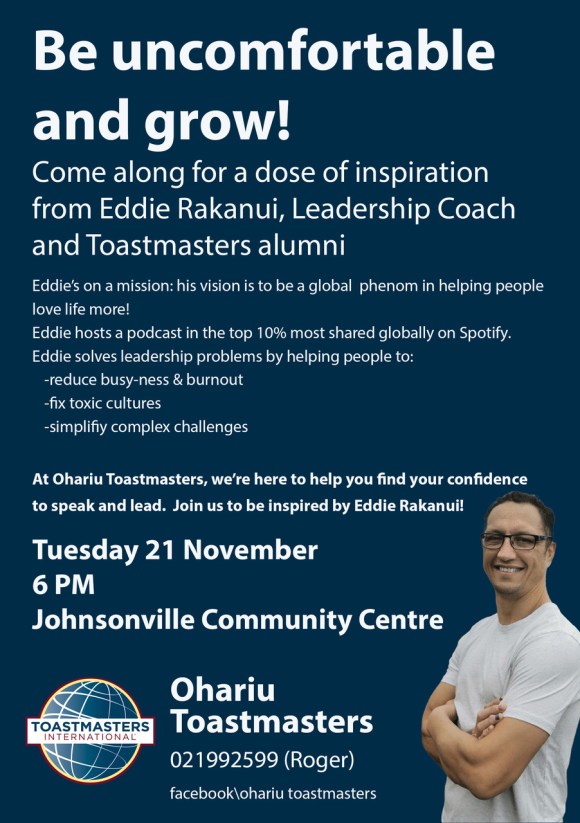
Ever wondered how Toastmasters works? Want a dose of inspiration? Come along to our open evening on Tue 21 Nov and hear keynote speaker Eddie Rakanui speak on “Be uncomfortable and grow!”
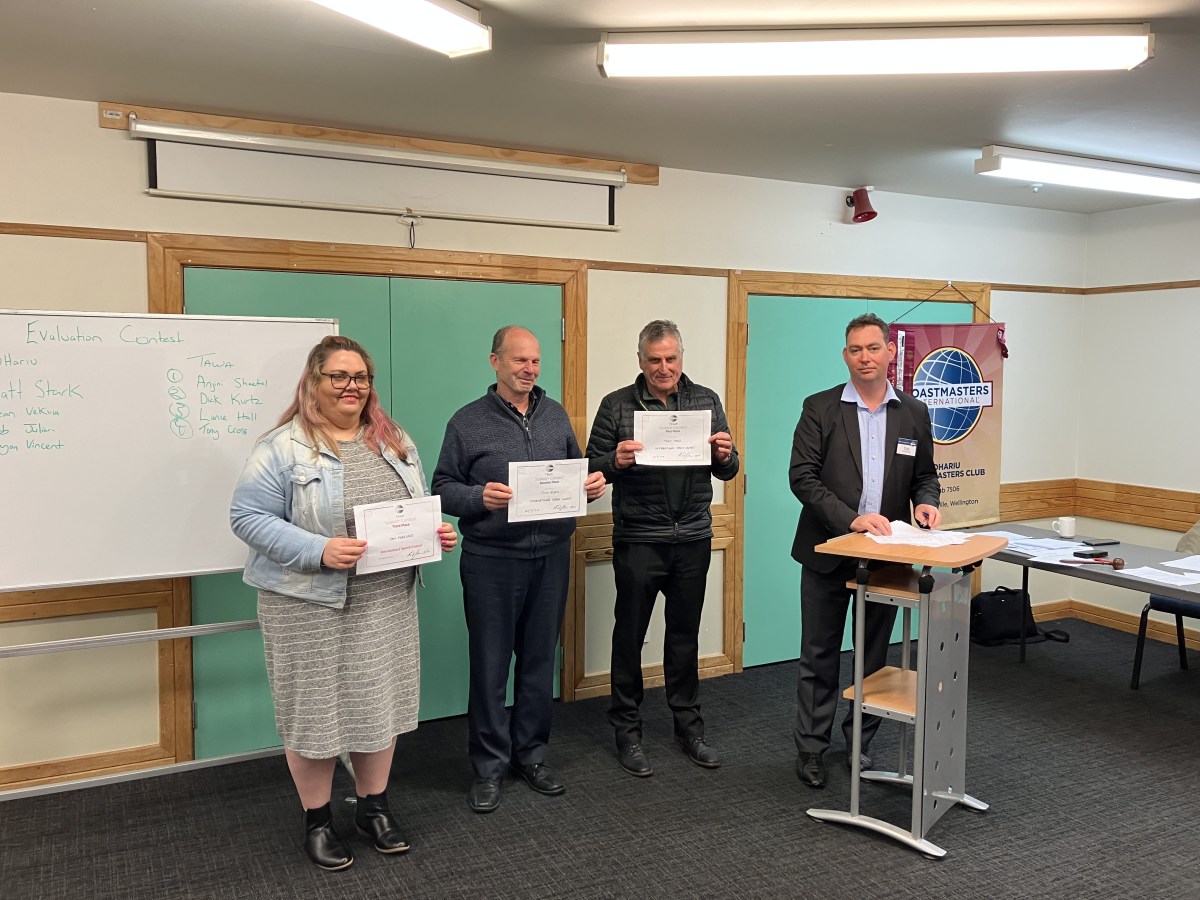
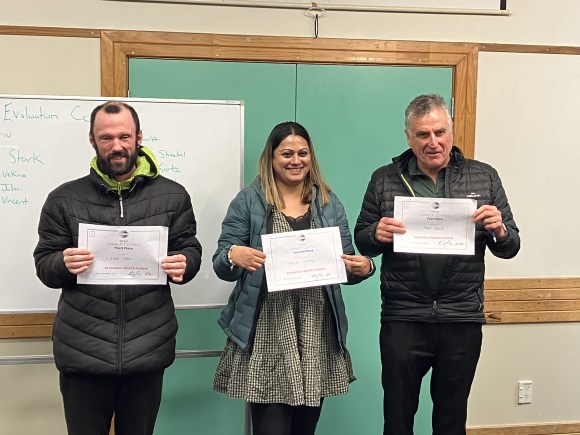
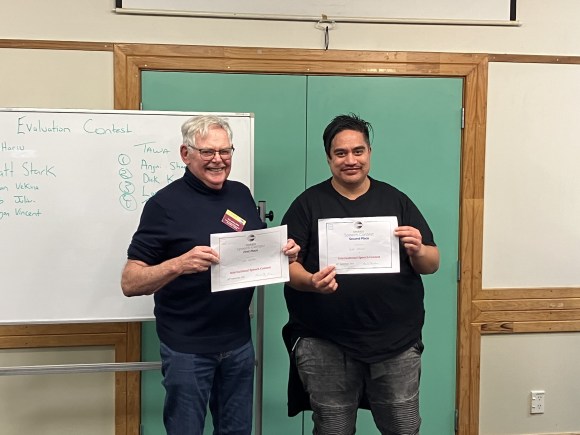
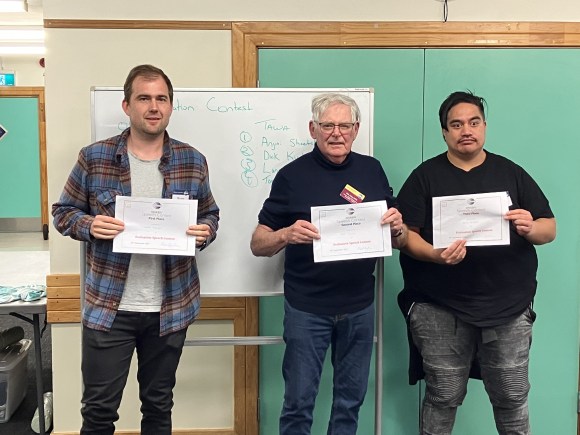
Ohariu and Tawa held their joint club contest on Tuesday 26 Sept. Lots of fascinating International Speeches + Evaluations of two test speakers. The photos of the jubilant winners say it all.
Tawa International Speech winners left to right – Amy Moreland, Dick Kurtz, Tony CrossTawa Evaluation winners left to right – Lance Hall, Anjini Sheetal, Tony CrossOhariu International Speech winners left to right – Rob Julian, Sean VekulaOhariu Evaluation winners left to right – Ryan Vincent, Rob Julian, Sean Vekula
This week’s meeting was full of inspiration. Shin Yee gave us a thought-provoking speech about cultural clash, telling us about her introduction to NZ culture when she first arrived in this country. There were messages in the speech and several people have encouraged Shin Yee to consider taking this speech further – Speech contests maybe?
And speaking of contests…we brought up YouTube and watched the winning speech from the 2023 World Championship of Public Speaking.
The winner, Jocelyn Tyson, gave an inspirational speech about overcoming self-doubt, using her personal experience of competing in a triathlon.
Under the heading of Faster, Higher, Stronger, I introduced members to the power of the Educational series: Better Speaking; Successful Club; Leadership Excellence. I am looking forward to members presenting projects from them as part of their skill growth!
Table Topics went higher as well – with questions around what might happen is aliens showed up! That inspired a number of interesting reactions.
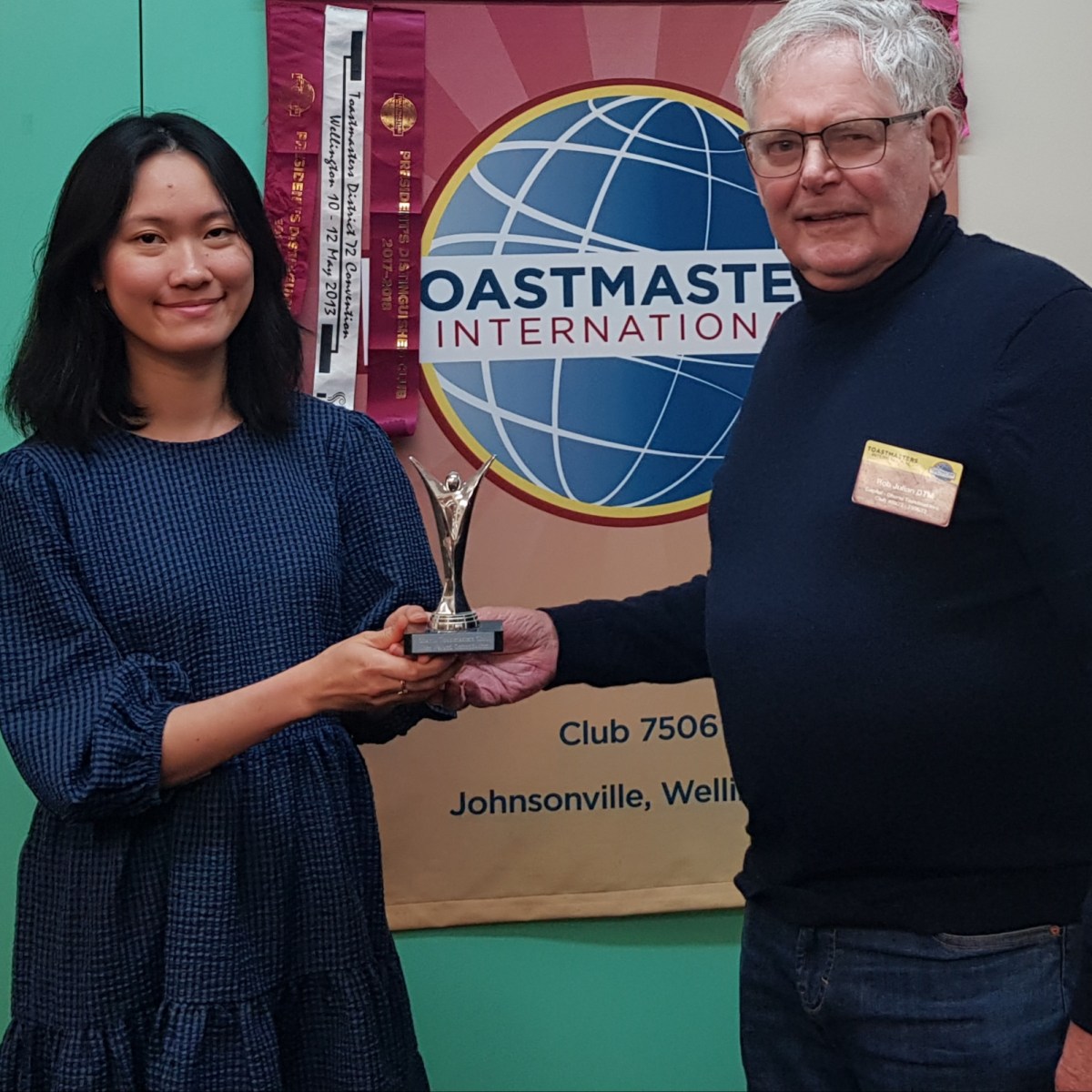
Photo shows Shin Yee receiving from Rob the best contribution for the night for her speech. Rob was general evaluator for the evening.
Shout out to Clare for the lemon cake, which did a disappearing act, ho ho.
Our club meeting in April featured on the TVNZ programme Good Sorts – a piece commemorating Rob Julian’s achievement of fifty years of being a Toastmaster.
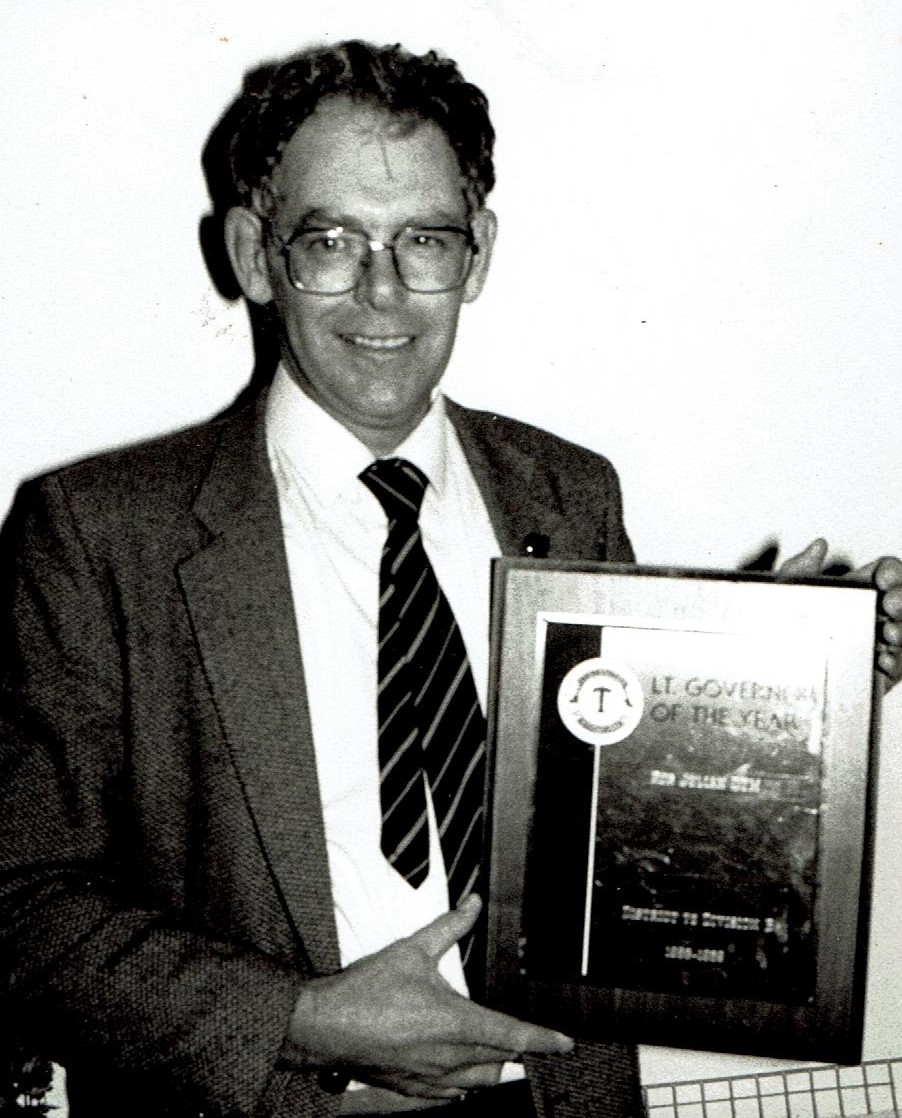
Lt Governor of the Year for District 72 (the whole of NZ).
by Rob Julian DTM
In the Beginning were the Words
In 1971 I was Teacher in Charge of Chemistry at Feilding Agricultural High School and realised that I had no social connections outside teaching. The staff, Post Primary Teachers’ Association, Science Teachers meetings, Diploma of Education papers at Massey University, and weekend dinners with the staff. I needed to get out and meet ‘ordinary’ people. The husband of one of the staff, Giles Beagleholm, suggested I come along to Palmerston North Toastmasters. I thought at the time that there was not too much point since ‘I was a teacher and knew all about public speaking’. Hah! I was thankful that the club had a huge solid lectern so that on my first Table Topic, no one could see my leg shaking uncontrollably as I spoke.
Meetings would last for 2 ½ hours due to the Master Evaluator re-evaluating everything. A person with what was to us the somewhat strange title of ‘Area Governor’, Peter Cooper, came and told us we needed to sharpen our act. Which we did and on my first role of Master Evaluator, I came up with so many ‘recommendations’, that the club voted me to represent them at the newly minted Evaluation Contest. I actually got to the National Conference (we were not a District) in Auckland. At Palmerston North, the lectern had three little lights on it, Green, Yellow, and Red, and I had always wondered what they were for since timing was done by ringing a bell. ‘Aha’, I thought as I came on to give my evaluation in Auckland, ‘that’s what the lights are for’. But when I looked at the lectern there were no lights. I should have stopped and asked the Chair where the lights were, but thought I could judge the timing by myself. Finally I saw the lights right at the back of the room, and the red light was on. I went over time and, of course, everybody told me I would have won easily if I had not been disqualified. It took me 10 years to finally win the District Evaluation Contest in New Plymouth.
Capital Toastmasters
In 1973 I was promoted to Head of Science at Newlands College in Wellington, and Peter Cooper phoned me to come down to the recently formed Capital Toastmasters club in the CBD where I remained a member until last year. There were giants there. The visitors book includes such names as David Abel, Tom Steiner, Blair Robertson, C. Tyler (President of AA), Joe Yates, John Welsh, and Trevor Gee. There is one entry of 27/8/75 with the name of Pamela Stirling ‘NZ Listener – Spy’. I can’t recall if she ever wrote an article about us.
Speeches were memorable. Trevor once gave a speech when he had been previously imbibing a little more than somewhat and from then on he was mentioned at just about every meeting on the dangers of settling one’s nerves with a good slug of whisky before speaking. I can still remember John Akers giving a speech on how to handle aggressive phone calls (he was CEO of a large organisation). You hang up on them. BUT, the trick was to hang up in the middle of something you were saying, not in the middle of what the complainant is saying. The person on the other end thinks the system is at fault and since the have made their views known, don’t bother to phone back. I found the technique works.
Club Lunches
Members of Capital who worked in the CBD used to meet twice a year for lunch at one or other of the well known watering holes. Then one meeting, accompanied by a bottle of wine, then another, then another, the members all decided that since it was 3.00 and none of them were in any condition to go back to work, they might as well stay and continue drinking. Which they did. Apparently their superiors at work were not too impressed with their actions and this was the last time lunches were held in the CBD.
Those Old Time Manuals
In those days, we had 6 speeches a meeting. But there was no Timekeeper’s Report and no Grammarian. And the Chair of each meeting introduced each speaker. Today most clubs only plan for four speeches so I am not quite sure what progress has been made.
The original CC manual, had 15 speeches and assignments to get through for one’s Competent Communicator award, and the Advance Manual, if memory serves had 12. To get a Distinguished Toastmaster Award one had to work through both manuals, appear on TV or Radio, start a new club, run Speechcraft and Youth Leadership, give outside presentations. and introduce 12 new members.
Women Appear
Up until I think 1975 Toastmasters was ‘for any man over the age of 18’. Toastmasters did sponsor Toastmistress clubs (who referred to themselves as ‘Crummy Bedmates) and the Wellington Toastmasters and Toastmistress clubs combined together for Area Contests. World HQ then said that clubs could chose to alter their Constitutions to ‘any person over the age of 18’.
Then followed three years of lively, passionate, and ardent debating at Capital Toastmasters which got everyone in the club up to speed on ‘Meeting Procedure’. Tom Steiner and I moved the motion ‘That membership of Capital Toastmasters be open to any person over the age of 18’.
The discussions were vehement.
If we allow women in the club we will end up with a whole lot of butch lesbian women telling us what to do.
Why would butch lesbian women want to join an all male club?
We will have to watch our language if women join. And we can’t tell dubious jokes.
But anyone using obscenities or telling dubious jokes gets hammered by the Master Evaluator.
If women join then I am resigning.
Well OK, your choice.
The first year, the motion was soundly defeated. The second year, it was only just defeated. The third year it was passed without much dissent at all and Larraine Talbot was the first woman member of Capital Toastmasters. (We got married some 25 years ago).
This killed Toastmistresses. Women joined the integrated clubs and Toastmistress clubs tried changing their name to Communicators Inc. but even those have disappeared.
The Great Investment Club Disaster
In the heady days of the 80s, at the break, various members, often lead by Joe Yates, talked about the killings they had made on the stock market in the recent two weeks. I was so impressed with the erudite expertise these people had that I suggested that we form a Capital Toastmasters Stock Market group and each advance $50 a month to be invested in stock that we would decide on at our monthly meetings. There were about 20 of us which gave us some $1000 a month to invest. I had a very cunning plan in all this. Since these guys were so expert at investing, I would make my own private investments in the stock they decided on. It was at the first meeting that I had the uneasy feeling that I may have misjudged the amount of expertise. Joe Yates recommended a stock I had never heard of.
What do they do?
What do you mean ‘what do they do’?
Well, do they manufacture things or what?
I don’t know. But it doesn’t matter. The point is that their value keeps going up.
Fortunately, we bailed out just before the stock market crash of the 87, but even so, during the Bull Market, we made a slight loss, as did I in my nefarious sub plot.
Getting involved
I had been frequently asked to be Club President and it got embarrassing to keep saying I was too busy teaching and taking University courses that finally I said ,’ no, I haven’t time to be President, but I will be VP Education’.
Hah! It didn’t take me long to discover that it is the VP Education that does the vast majority of work in the club. But I learned two very valuable lessons –
How to organise my time to maximise results, and
Never stand for committee membership but always say you will be President – providing you can get an efficient and dedicated secretary.
As a result my teaching career skyrocketed – except it was out of teaching into administration, and I became President of NZ Science Teacher Association, and President of the Wellington Marathon Clinic – not because I was good at running marathons, but because I was good at running meetings. And I went on to take the role of Area Governor, and Divisional Governor twice, as well as receiving a plethora of the District 72 awards. Doris Moore Trophy, Division Governor of the Year, Don Harden Award of Professionalism, leading Capital and Ohariu Club to Jack Duffy Ward, and winning the District International Speech, Evaluation, and Humorous Speech Contest, (but only coming second in the Impromptu Speech Contest – unfinished business). Except, such is the standard in Toastmaster Public Specking, that now I can’t even win a club contest.
Impromptu Speech Contest sneaks in
The Impromptu Speech Contest is interesting. Originally members attending the District Conference were invited to put their names in a hat and six were drawn to take part in a 5/6/7 minute Impromptu Speaking contest. Eventually John Fauvel donated a cup to be awarded. Inevitably a motion was moved at what I recall as an Auckland Conference that the Impromptu Speech be held as a Club, Area, Division and District contest. The District Treasurer was adamant that the District could not afford it but the motion was passed. Each contestant was given an envelope with two topics inside, One a ‘serious’ topic and the other ‘humorous’. Upon reading the topics there was one minute to decide and think about how to start. It sounds tough, but one could sort of work one’s way into the topic. Today, with only 2 1/2 minutes once you start you are committed and cannot change your mind about how to approach the topic. But insofar as the contestant did not have to announce what the topic was, eventually contestants gave a speech they had previously given at the club level. Mind you, the same thing happens now. Eventually TI told us we either had to change to 1/1.5/2 minutes or elect to run the ‘Tall Tales’ contest.
Community Involvement and having fun.
It is odd, but in the days when we had only four clubs in the CBD, we were much more active in the community and frequently called upon to help out in events in Wellington.
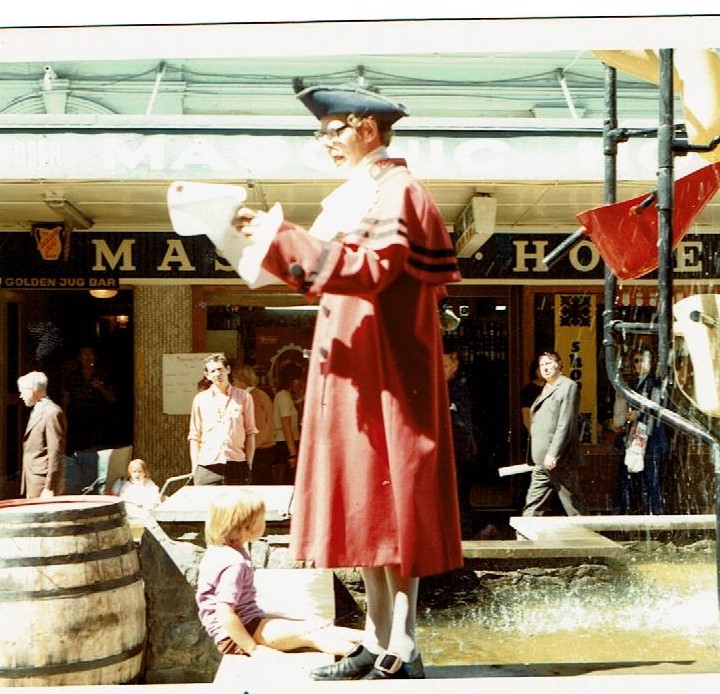
We organised a roster of Town Criers in a festival of Wellington where the Council had two handsome Town Crier Coats and hats and various of us spent 30 minutes in Cuba Mall each lunchtime issuing edicts and promoting events. (I found that after 30 minutes shouting Oyez! Oyez! My voice gave out). And I was asked to MC the Saturday events in Civic Square. I recall having to introduce Geoffery Owen the World Champion Shearer. I don’t know what happened to the Town Crier outfits. Presumable buried in some dark and dingy cupboard. In Council storerooms.
We also participated in other speaking events. Capital had a team in the A Grade Wellington Speaking Union Debating Contest. Myself, Larraine, Tom Steiner, and others. We never actually won a debate but we were always told that we ‘were the most promising team in the A Grade contest’.
We were frequently asked to adjudicate or chair Debating Contests of Community Clubs in Wellington. Lions, Rotary, and even High School debates.
We always entered the Wellington Speaking Union Speech Contests and sometimes won. (They had different judging criteria).
I am well aware of the quote by novelist LP Hartely ‘ that the past becomes a distant country, they do things differently there’, but it seems to me we used to have a lot more fun than we do now. I sometimes wonder if we are so pressured into chasing Distinguished Club Management points to the exclusion of all else, that we don’t get time to relax and do anything different.
I have been involved in running some 20 Speechcraft Courses and over 30 Youth Leadership Courses, and Wadestown ran one for the Year 8 Shannon School students this year. But clubs don’t even get DCM points for running Youth Leadership Courses
So how have things changed in Toastmasters in New Zealand.? There is still the same enthusiasm and dedication among members, but growth has been exponential. When I became Area Governor of Area B4 there were only 6 clubs in the Area, Wellington, Capital, Endeavour (since collapsed), Tawa, Porirua, Hutt Valley, and Masterton. Now there are 56 in Hutt Valley and Wellington alone. But there is concern about the number of clubs throughout New Zealand in the now District 112 and 72 that are collapsing. When I was Club Coach Coordinator in 2005/6 there were only 6 clubs in the whole of NZ with membership under 12 that needed a club coach. Now there are dozens.
The once bastions of Toastmaster clubs of Wellington and Capital regularly had between 20 – 26 members at a meeting. Now they are lucky to get to double figures. It is possible that we out-reached ourselves, or more likely in my view that the older members have trouble adjusting to Pathways and prefer the old system of having a manual to follow and don’t renew their membership. If so, then the newer members who only know Pathways will eventually predominate. And, interestingly Ohariu now has a membership of 27 with one or two guests each meeting. And over 60% of new members have English as a second Language. They are probably the way of the future.
One of our members, Andy Southall, is pleased to have his novel Both Feet in Paradise shortlisted for the NZ Booklovers Award for Best Adult Fiction 2022.
Hear Andy talk about his book, together with all the other shortlisted authors on KickArts, Planet FM 104.6 at 8pm on Sunday 27 Feb. Here’s an example of putting Toastmasters training to real use.
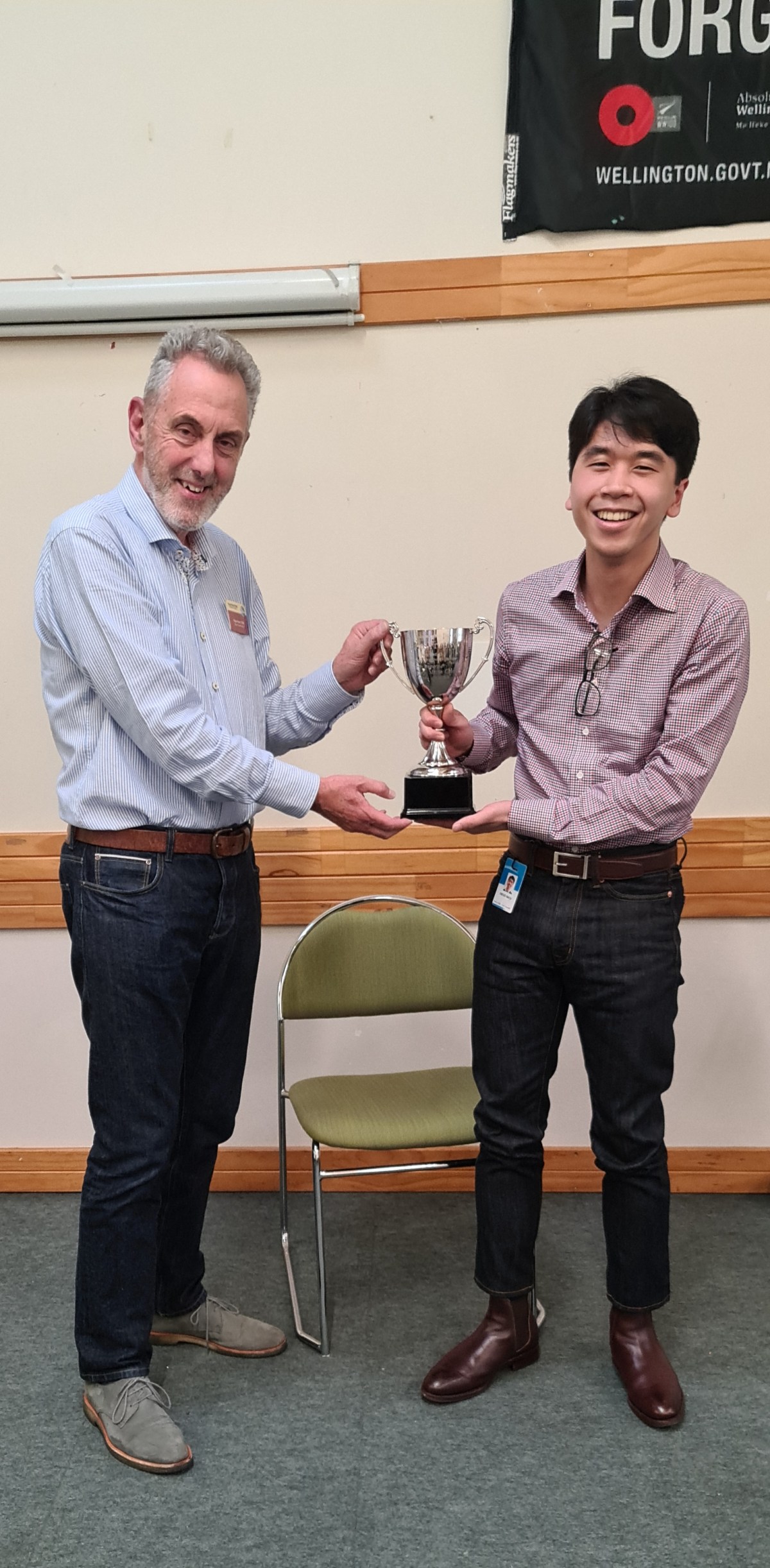
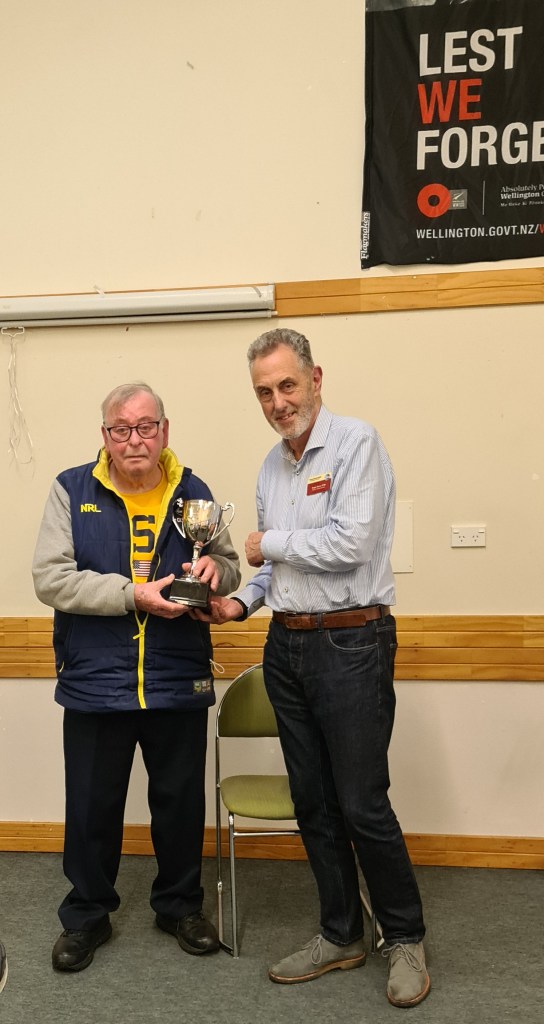
Diego Nacu is the inaugural recipient of our new Gale Trophy for the Most Improved Toastmaster of the Year. Diego received the award as a recognition of his personal growth in the 2020-2021 Toastmasters year.
The trophy is named in honour of Mathew Gale. Mathew passed away unexpectedly in 2020 while serving as club president. In just a few years Mathew had transformed from a young man who suffered panic attacks when asked to speak into a leader taking on senior club roles. His story of personal determination and growth inspired everybody who knew him.
The trophy was presented by Mathew’s parents in memory of the passion with which Mathew approached Toastmasters and of his achievements through the Toastmasters programme. We are proud to receive the trophy and to be able to recognise personal achievement in such a tangible way.
Diego received the award in recognition of his own growth in confidence – another younger member who joined Toastmasters to acquire speaking and leadership skills to help his career.
This blog tells you all about Toastmasters Speech Contests. Other important resources are the Toastmasters International Website, Resources tab and the official rulebook.
Speech Contests are a fantastic opportunity to extend yourself in Speaking or Leadership with multiple roles available. I encourage you all to get involved in some capacity. There are plenty of people in the club that are have this experience and will be happy to answer any questions you might have.
The 1st and the most important role is: CONTESTANT. Without Contestants there is no Contest and I encourage you think about this if extending yourself in a speaking role is something you want to do. Give it a go!
There are 4 Contests:
Humorous Speech Contest – 5/6/7 Minute Speech – with Humour only a small part of the criteria.
Table Topics Contest – Everyone gets the same topic. An impromptu 1/1.30/2 minute speech, where you speak to the topic when it’s your turn to enter the room.
Evaluation Speech Contest – 2/2.30/3 Minute Speech, where you have five minutes to prepare your notes, then evaluate the same test speaker in the order you’ve drawn.
The Only requirement for the Humorous, Table Topics and Evaluation is to be a member of good standing in a club of good standing (put simply, you have paid your membership dues).
4. International Speech Contest – Requirement of completion of Competent Communicator Award or Level 1/ 2 in Pathways. This is a 5/6/7 minute speech. The International Speech is the one that starts at Club Level and goes onto Area/Division/District/Region/ Toastmaster International Semi Final/Final. If you wish to enter International Speech Contest, let your VP Education know and he/she will be happy to schedule the speaking slots.
Another opportunity is being a test speaker at another club where you’ll gain valuable feedback from other Toastmasters. OFFICIALS.
As you know, every event has people behind the scenes to help make it run smoothly. Speech Contests are no different and there are multiple roles that need filling and provide learning opportunities!
The CONTEST CHAIR: This is the person who runs the contest on the night. Their main responsibility is to get all contestants to sign eligibility forms, remind them of the rules and do the draw to determine in which order they will speak i.e. 1st, 2nd ,3rd,4th ,5th. The Chair also reads a Contest Script (Which can be downloaded), plus welcome and lead applause for each contestant as they enter the stage for their turn to speak. Later the Chair presents Participation Certificates and conducts interviews with all contestants.
TIMERS The role is for 2 people to record the time of the speakers at the contest on an official form, and operate the lights as per usual. The main difference is that at the contest there is no notification if speaker goes 30 seconds over the allowed time. The Chief Judge will collect the Timers’ Report at the end of the Contest.
SERGEANT AT ARMS This role is to ‘monitor the door’ at the start of the contest to stop people leaving the room. There is a 2nd Sergeant at Arms required to stay with the Contestants outside the room until it’s their time in the draw to speak.
TALLY COUNTERS This role requires 2 people to collect envelopes from Judges at the end of the Contest and leave the room with Chief Judge. The scores are tallied up and official paperwork with places is completed. Certificates are written up ready to the 1st, 2nd , 3rd placed Contestants.
CHIEF JUDGE This role is organize Judges before the Contest and have the required paperwork needed for the Contest. Before the Contest brief all the official roles including Judges which is done in a separate briefing. The briefing for Judges is sign eligibility forms, go through speech criteria for contests and ideally they should remain anonymous.
The Chief Judge may have to deal with any potential protests. After the Contests, the Chief Judge works with the Tally Counters to sort all paperwork and pass this onto next level organizer i.e. the Area Director.
JUDGES Ideally Judges should be neutral at a Contest, and this is an opportunity to swap with other clubs in the Area and beyond. A fantastic chance to visit other clubs and meet Toastmasters.
To be a judge just requires a bit of training (that can be given) and is giving to feedback to speakers through using Judging Form Criteria.
I encourage everyone to think about taking up a role. Toastmasters is about learning and Contests are a fantastic opportunity






 Ohariu Toastmasters